Evening and weekend appointments available
Uneven tone, sun spots, redness, and rosacea are among the most common skin concerns — and among the most treatable with the right technology. At Trinity, we use targeted laser and IPL to reach the root of discoloration: the brown pigment and the red, vascular concerns beneath the surface. The skin clears them naturally, leaving tone more even and genuinely brighter.
Discoloration comes down to two things sitting in the skin where they shouldn’t be. Brown concerns — sun spots, age spots, melasma, freckles — are melanin, the skin’s own pigment, overproduced and unevenly distributed after years of sun, hormonal shifts, and inflammation. Red concerns — rosacea, flushing, broken capillaries, spider veins — are hemoglobin, visible through tiny dilated or broken vessels near the surface.
Because these are two different targets, they respond to different light. The principle behind every color-correction treatment is the same: deliver energy at the exact wavelength a given target absorbs, so it’s broken down without harming the skin around it. The body then clears the fragmented pigment or reabsorbs the treated vessel over the following weeks, and tone evens out on its own.
This is also why no single setting fits every concern. Matching the right wavelength to the right target — brown versus red, deep versus superficial — is what makes correction precise rather than aggressive, and it’s the reason having more than one technology on hand matters.
Color correction is the use of light to remove what’s discoloring the skin — without bleaching it, sanding it down, or masking it with makeup. It works on a principle called selective photothermolysis: any target in the skin absorbs some wavelengths of light and ignores others. Choose the wavelength a pigment or vessel absorbs most strongly, and the energy is taken up by that target alone, leaving the surrounding skin untouched.
Once the target absorbs that energy, one of two things happens. Brown pigment is broken into particles small enough for the body’s own immune cells to carry away over the following weeks. Unwanted blood vessels are heated just enough to seal closed, then quietly reabsorbed. In both cases the skin isn’t removed or wounded at the surface — the discoloration is dismantled in place and cleared naturally, which is why most color correction needs little or no downtime.
No single wavelength reaches every target. Brown sits at a different depth than red; a pinpoint broken capillary calls for different light than diffuse, all-over flushing. Matching the right wavelength and the right device to each specific concern is what separates precise correction from a one-setting-fits-all approach — and it’s why having several technologies available, rather than one, lets the plan follow the concern instead of the other way around.
Different discoloration calls for different light. At your consultation, your Trinity physician matches the right technology — sometimes more than one — to the specific concern, your skin type, and your goals.
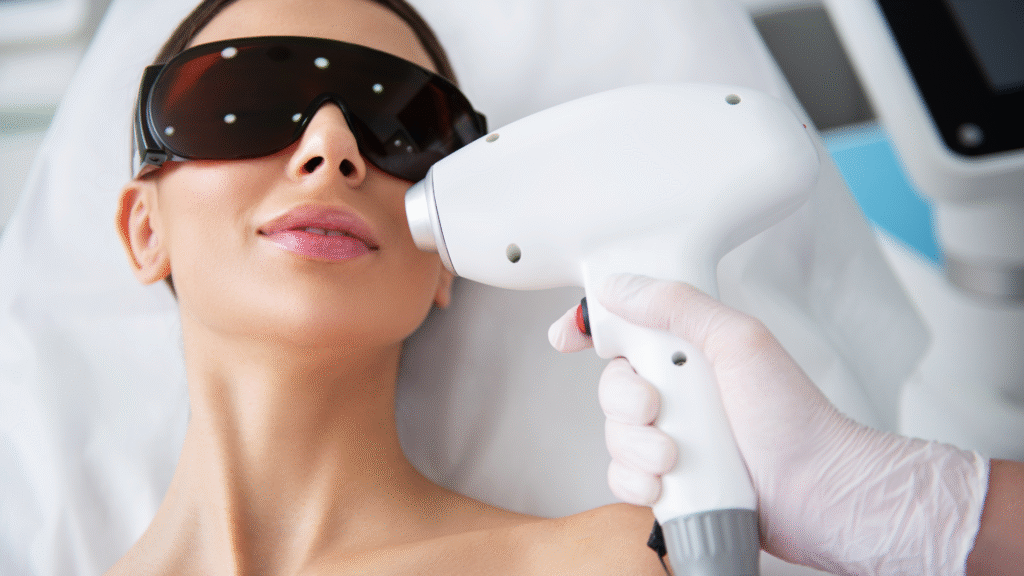
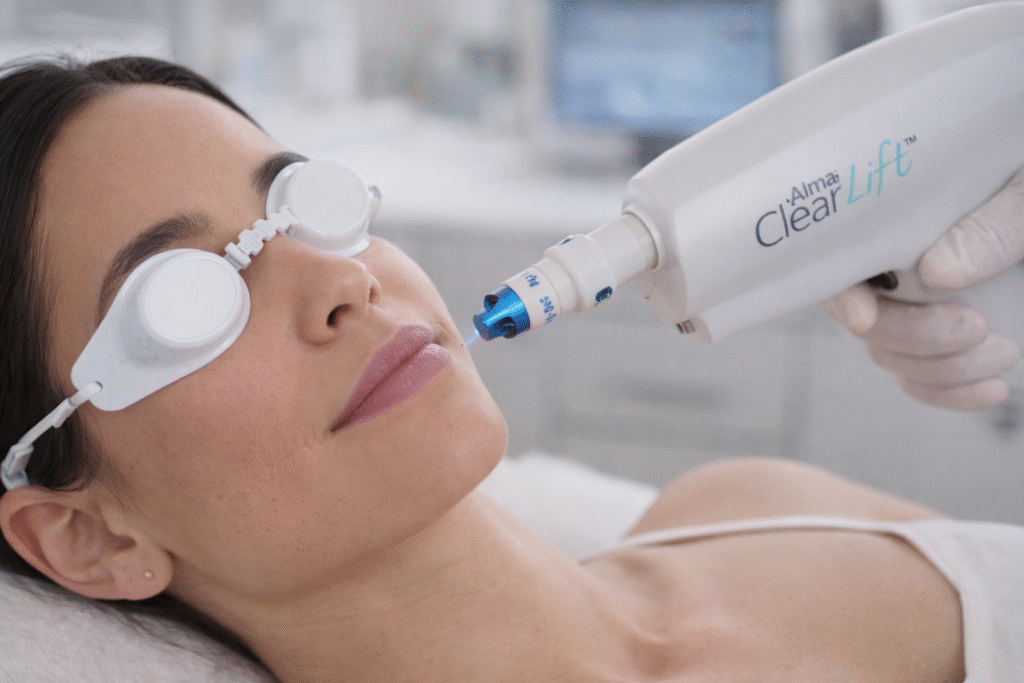
Sun spots, age spots, melasma, freckles.
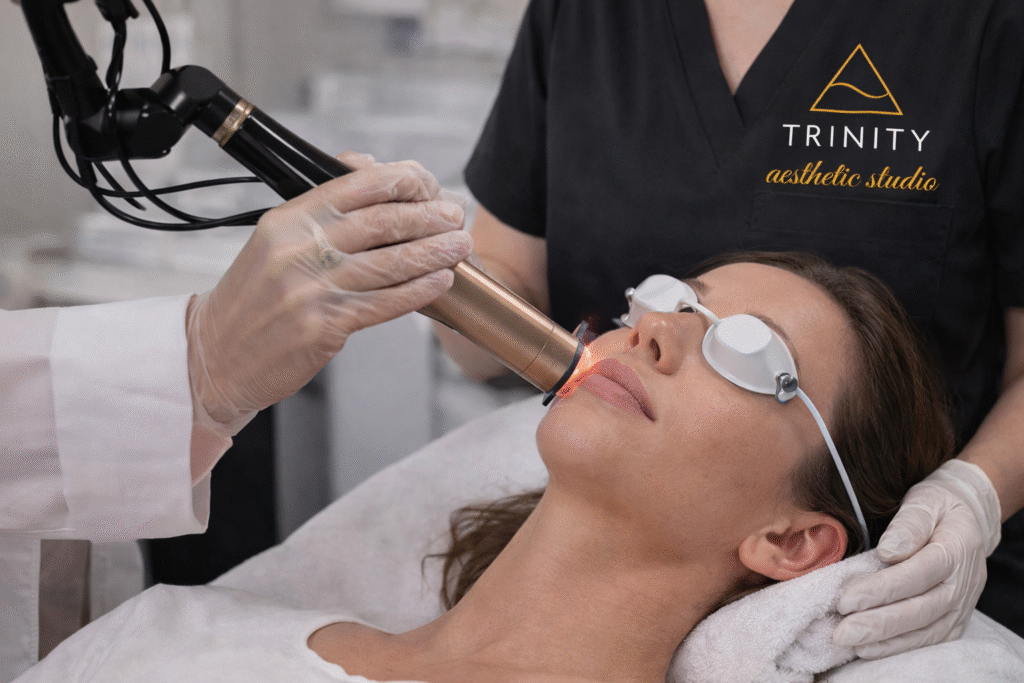
Brown discoloration responds to Q-switched laser light tuned to the depth of the pigment — the ClearLift Pro’s 1064nm wavelength reaches deeper, dermal pigment, while its 532nm targets superficial spots and freckles. Both break pigment into particles the body clears on its own. Suitable for a range of skin types; your physician confirms the right approach for yours.
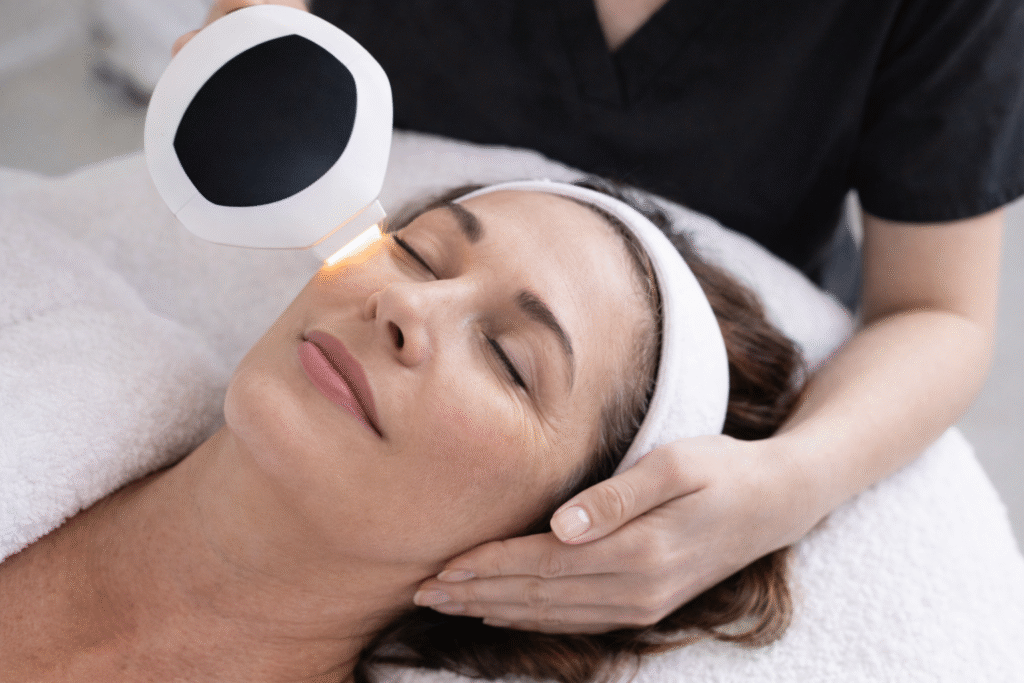
Diffuse facial redness, flushing.
Broad, blush-like redness and rosacea respond best to IPL — light delivered across a wider area, absorbed by the hemoglobin in dilated surface vessels. Trinity uses Dye-VL, a narrow-band IPL tuned for vascular and pigment targets, more comfortable and more controlled than older broadband devices. Treats the face, neck, and décolletage.
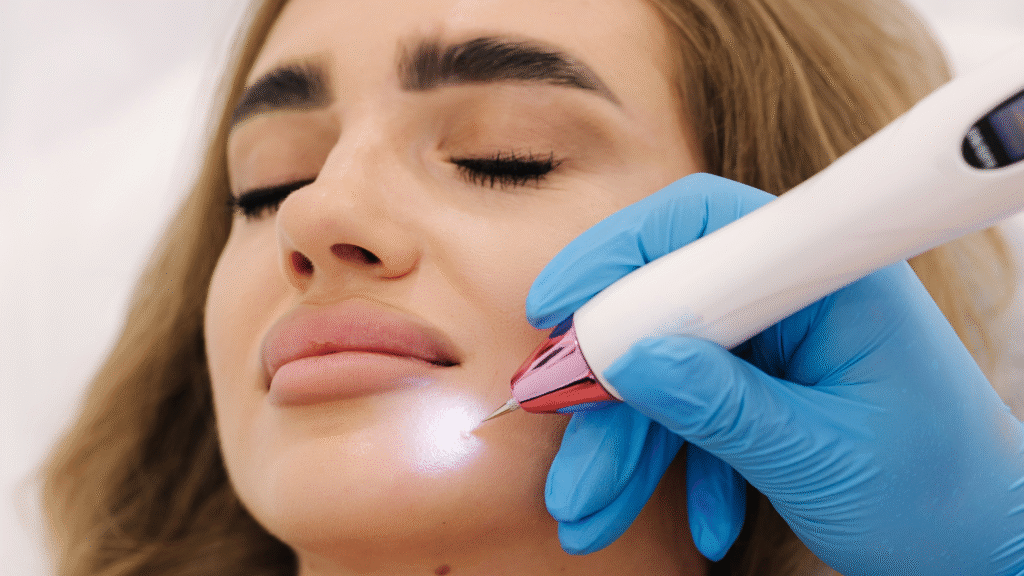
Broken capillaries, spider veins, cherry angiomas.
Individual visible vessels call for precision rather than broad coverage. VascuPen, a green-light diode laser, targets a single capillary, spider vein, or cherry angioma directly — heating it until it seals and is reabsorbed, with minimal effect on the skin around it. Works on the face and body.
Maintain results, prevent recurrence.
Light clears existing discoloration; daily skincare keeps it from returning. Medical-grade topicals calm pigment-producing cells, while consistent sun protection prevents the UV exposure that drives most pigment back. Physician-selected to work with the skin’s biology, not against it.
A lot of pigment and redness gets treated with whatever single device a practice happens to own. Trinity starts from the concern instead: what’s actually causing this discoloration — brown pigment, broken vessels, diffuse redness — and which light clears that specific target most precisely.
That comes from how Trinity is built. The practice is physician-founded, and its founders think in terms of what’s physically happening in the skin, not just how to lighten the look of it. And because Trinity keeps several distinct color-correction technologies on hand — Q-switched laser, vascular laser, and IPL — a given concern can be matched to the right wavelength rather than forced onto the only device available.
It also means the tools work together. A laser can clear the pigment that’s already there while medical-grade skincare and sun protection keep it from returning — addressing both the discoloration and the cause behind it. Your physician designs that plan at your consultation, around the concern you actually have.
Every plan starts with a complimentary consultation and Alma IQ skin analysis — a close look at the pigment and vascular concerns on the surface and below it, before any treatment begins. Your Trinity physician identifies what’s causing your discoloration and matches the right technology to it.
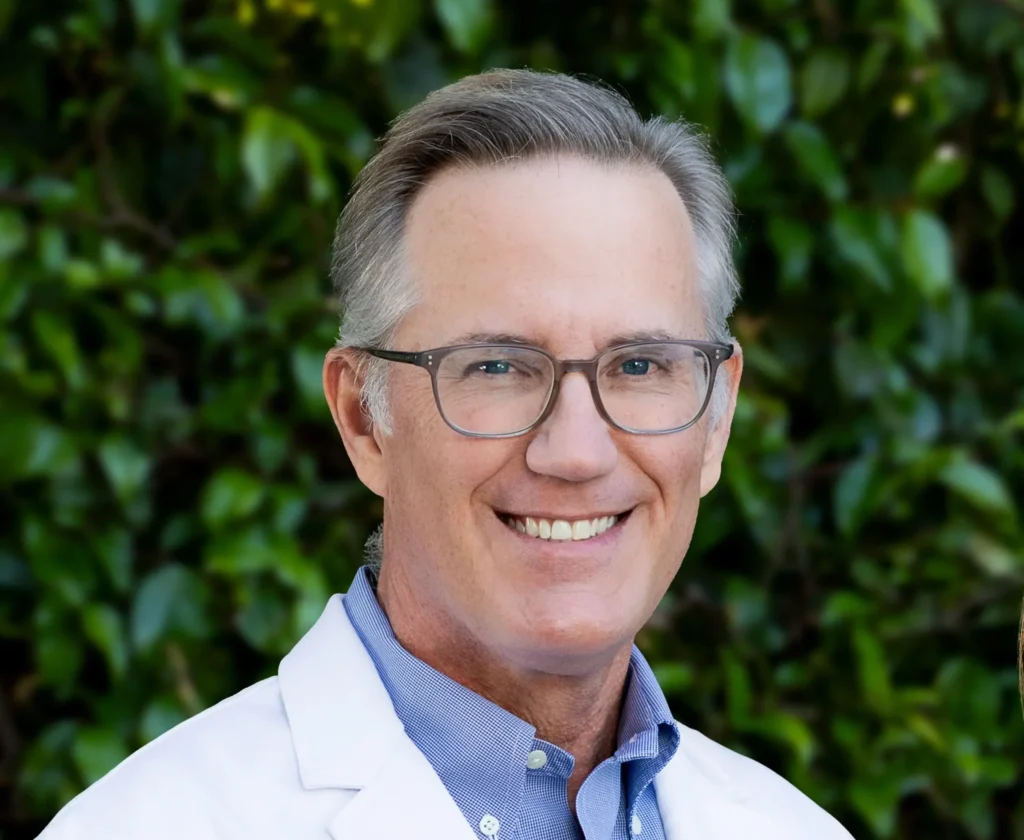
Dr. Oliak has spent his career drawn to fields of medicine that are genuinely transformational for patients — the kind of transformation that changes not just health, but how people feel about their lives.
That journey began with bariatric surgery. Over a 20-year surgical career, Dr. Oliak performed more than 3,500 operations — including as one of Orange County’s first surgeons to offer laparoscopic weight loss surgery — helping patients achieve outcomes that rippled across every dimension of their lives: physical, medical, and emotional. The benefit came not from the surgery itself, but from what the body achieved once the conditions for change were in place.
That insight shaped everything that followed. In 2023, Dr. Oliak founded MD Total Wellness on a simple but powerful conviction: that the body has a remarkable capacity to heal, rejuvenate, and restore — and that when given the right signals and raw materials, it does this better than anything we can artificially impose. Hormone therapy restores what aging takes away. Peptide therapy stimulates the body’s own pathways to achieve meaningful outcomes. The body, properly supported, does things better than we can artificially replicate.
Aesthetics became the natural next chapter. The same technology-driven, root-cause philosophy applies — advanced energy-based technologies and regenerative skincare stimulate the body’s natural processes to address the underlying causes of aging at every layer — from the structural foundation to collagen and skin surface. At Trinity, that means starting with the foundation — rebuilding muscle and connective tissue — before addressing collagen, and refining the surface last. Achieving results that are compelling precisely because they are natural. Everyone wants to look and feel their best — Dr. Oliak believes the body can get us there on its own terms.
At Trinity, Dr. Oliak brings a combination of surgical precision, deep scientific grounding, and a genuine passion for patient transformation — helping people not just look better, but feel better about who they are.

In Dr. Krishnan’s own words:
My work has always been shaped by a simple but profound conviction: that the face is not a surface to be perfected — it is a living system to be understood, respected, and supported.
Over more than 20 years of full mouth rehabilitation and restorative dentistry, I have come to see every smile as something far more than an aesthetic outcome. A smile is connected to the face, the muscles, the way a person moves, communicates, and expresses who they are. That understanding — of the head, neck, and facial system as a whole — is the foundation of everything I do, both in dentistry and at Trinity.
My clinical training at the University of Michigan School of Dentistry gave me a rigorous foundation in precision, proportion, and restorative excellence. But what has defined my work over the years goes beyond technical standards. It is a commitment to pushing past them — through innovation grounded in science, not trends. Every decision I make — shape, proportion, occlusion, material, treatment — is guided by one question: will this harmonize with the body’s natural expressions, preserve its integrity, and support its long-term health?
I have a deep resistance to the idea that aesthetics should depend on masking or on creating dependency. There is a meaningful difference between treatments that simply change how someone looks and treatments that restore and enhance the body’s own capacity to function and heal. That distinction matters to me. It is why I am drawn to biocompatible, structurally sound approaches — treatments that work with the body’s biochemical and physiologic processes, not against them. Because if someone is investing in looking better, it should also mean becoming healthier.
I feel strongly about muscle. Not as an obstacle to smooth away, but as something essential — to movement, to expression, to identity. We speak with our muscles. We smile, connect, and live fully through them. Treatments that diminish natural movement work against the very systems that make us human. Preserving muscle function is not just an aesthetic choice — it is a commitment to longevity and vitality.
Trends in beauty come and go, driven by marketing cycles that shift and disappear. But timeless beauty operates differently. It is rooted in confidence, authenticity, and the ability to fully express yourself. That is what I am committed to — for every patient, in every treatment decision.
This philosophy is what brought me to co-found Trinity with Dr. Oliak. In aesthetics, as in dentistry, the goal has never been to override nature. It has always been to support it — using the best available science and technology to help the body do what it already knows how to do, only better. Because an exceptional result isn’t just seen. It’s felt — by you, and by everyone around you.
I would love to be part of your journey.
— Gail Ann Krishnan, DDS, MS